'Mass Die-Off': Thailand's Seagrass Crisis and the Island Fighting Back

We all know about the coral bleaching crisis, but not the seagrass tragedy. This is an ecosystem dying out entirely, and in heartbreaking silence. Seagrass is one of the three vital marine ecosystems alongside mangroves and coral reefs.
Seagrasses are the world's only higher plants that live entirely submerged, with approximately 60 species worldwide, and Thailand is home to 13 of them. These meadows shelter dugongs, grouper fry, blue swimming crabs, and tiger prawns. Professor Thon Thamrongnawasawat, Associate Dean of the Faculty of Fisheries at Kasetsart University says: "If our knowledge of corals is at 100%, our knowledge of seagrass is only at 5%. In just the past two years, 80–90% of seagrass has disappeared."
According to the International Union for Conservation of Nature (IUCN), seagrass absorbs 7–10 times more carbon than terrestrial forests and at least twice as much as mangroves. It is the world's most efficient carbon sink. The problem is that marine heatwaves and extreme low tides are killing it at a rapid pace and restoration has felt almost impossible. Until now, on a far-away island in eastern Thailand.
To the people of Mak Island, known as Koh Mak, marine resources are their lifeline. Ung-Noppadol Sutthithanakul, Chairman of the Koh Mak Coral Conservation Group, has been diving these waters for decades, always passing through vibrant green seagrass meadows acting as a natural wave barrier and sanctuary for juvenile marine life. Then suddenly, the seagrass meadows started disappearing.
In the last 2–3 years, the water has heated up to more than 34°C. If you dip your leg in, you jump! The ideal temperature for seagrass is 29°C. The sun is intense, the low tides last longer. Sometimes the grass is exposed for half a day and scorches to death.
Professor Thamrongnawasawat added that research teams have measured seabed temperatures as high as 40°C. Seagrass stores energy in its roots, but the heat is now so extreme that the roots are rotting. "The Tape Seagrass (Enhalus acoroides) is the 'perennial tree' of the sea. It can live for 30-40 years. It is more like ginger," and it reveals a secret hidden beneath the seabed.
Thailand's largest seagrass species, the Tape Seagrass leaves can reach 2 metres while its underground rhizomes can also grow equally deep 2 metres, weaving together like a carpet. Its carbon-absorbing power is extraordinary: 10% is stored in the leaves which trap carbon-rich sediment, and 90% is locked in the underground roots for hundreds of years, quietly cycling carbon out of the atmosphere and into the earth.
For 15 years, Kasetsart University has searched for restoration methods that disturb wild plants as little as possible. Chatcharee Kaewsuralikhit, Head of the Seagrass for Climate Action Research Unit, explains: "Digging up rhizomes to replant works, but it destroys the existing source. We focused on growing from seeds and tissue culture."
One seed takes two years to become two plants - too slow. Tissue culture, a technique that grows a tiny piece of plant into a full new plant in a controlled environment, became a beacon of hope. After a decade of trial and error, the team has successfully stimulated one seed to produce 300 shoots. This is the first seagrass tissue culture lab in Thailand and in the world. The discovery has been patented to prevent commercial exploitation and ensure it serves nature. They began moving plants to sites where seagrass once thrived, such as Koh Mak.

This tiny island is owned by just five major families, all aligned on a single vision: a Low Carbon Destination. Koh Mak screens its visitors carefully. A ferry ticket costs ten times the average. Its "Koh Mak Charter" bans parties and damaging water activities, earning a spot on the Top 100 Green Destinations global award. These quality-minded tourists are precisely the ones who will help plant, monitor and fund seagrass conservation.
In 2022, the research team invited private-sector funding to scale the project. By 2024, Koh Mak had Thailand's first community-led seagrass nursery and a year later, the Seagrass and Coral Learning Center had officially opened. Gloyta Nathalang, Executive Vice President at Bangchak Corporation, reflects: "Our original intention was carbon absorption for Net Zero. But as seagrass began dying off, we pivoted to conservation first. We've seen many learning centrers built, only to be abandoned. This one truly belongs to the community."
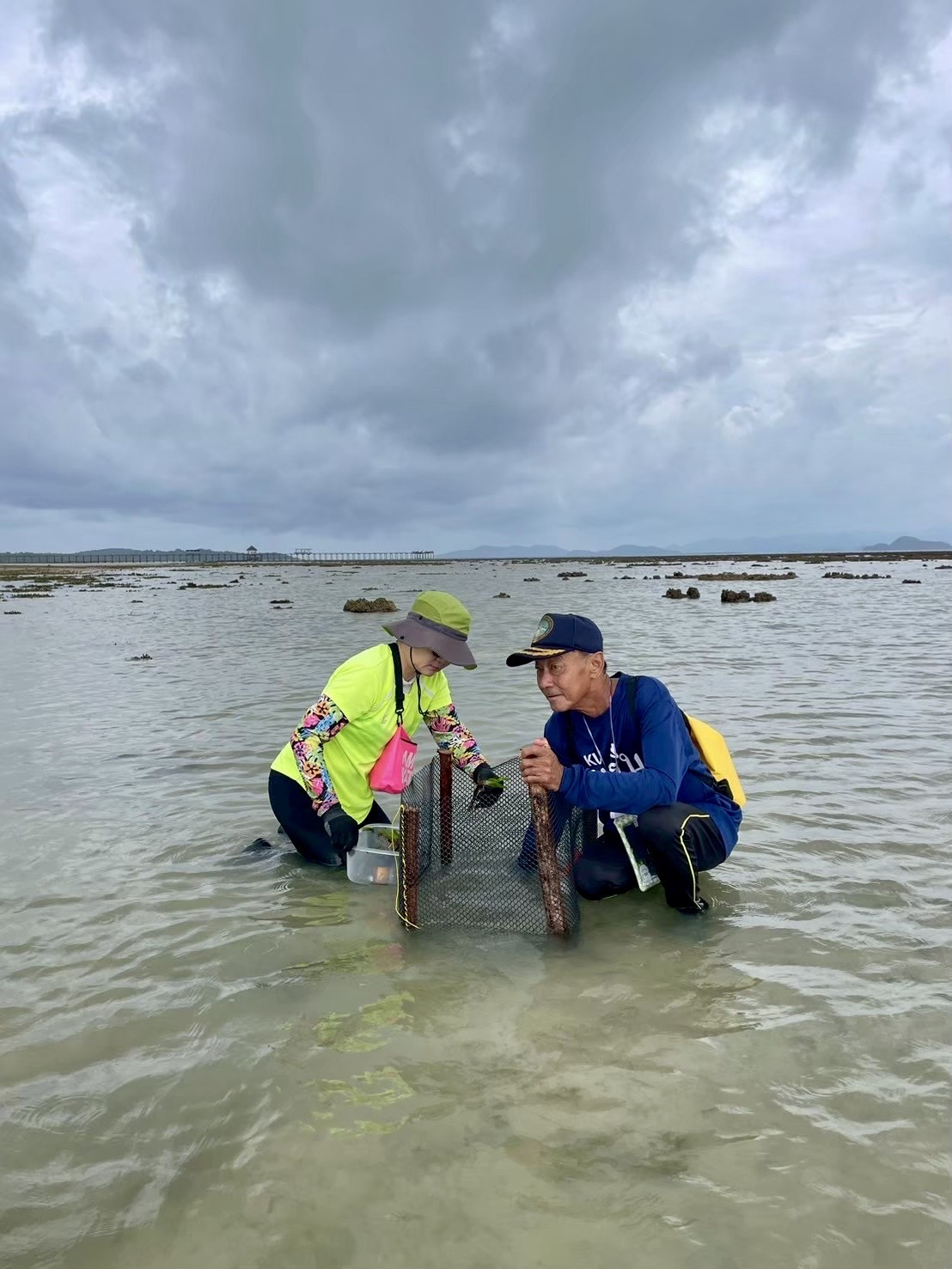
Growing plants is only half the battle. To give seagrass the best chance of survival, researchers and local villagers walk over 10,000 steps every low tide, measuring elevation and collecting soil samples across the tidal flats. The effort produced a Google Earth-compatible Seagrass Planting Guide with exact coordinates for planting.
Young seagrass is like a toddler. It needs human care. George Gander, a 17-year-old British-Filipino islander, teaches visiting students to place seedlings in coconut fiber pots, passing on a stewardship that will outlast any single generation. Seagrass seedlings take two years to fully take root and form a stable meadow: cultivating at the research station, transferring to Koh Mak for six months, locating using the map, planting, then monitoring monthly.
Last year, a severe storm swept away three protective cages. One remained, and new ones have been put in place. At least the Seagrass for Climate Action Center is open for everyone to help. On a clear day, walking by the sea on Koh Mak, you might just see the young seagrass fighting back, reclaiming its place as a home for marine life and a blue carbon sink for our planet.

This article is based on information available to the author at the time of writing. In some contexts, independent verification of all information may be limited by access restrictions, reporting conditions, or the availability of sources.
SHARE is an ifa platform for voices and perspectives from different countries and contexts. All articles are written by alumni of ifa programmes. The views expressed are those of the author and do not necessarily reflect the views of ifa.
Learn more about our Editorial Values & Standards.